
Table of Contents
- Brief Guide: Why UAE Branded Residences Outperform the Market
- The Brand Premium Phenomenon: The Financial Math of Trophy Real Estate
- The Dubai Market Bubble — Myth or Reality for Ultra-Luxury?
- The Social Filter: How Elite Infrastructure Impacts Property Liquidity
- Investor Checklist: Rules for Safely Selecting Branded Real Estate
- Frequently Asked Questions (FAQ)
A branded residence is a highly liquid financial instrument where paying a 25–35% premium for the name of a global hotel or automotive brand acts as a guarantee of construction quality and capital protection against inflation. By purchasing a premium project with a Bvlgari, Armani, or Mercedes-Benz logo on the facade, an investor is not paying for ego, but for an independent developer audit, predictable ROI, and access to a closed-door social infrastructure. Over 25 years of managing assets in international markets, I have seen firsthand that in the ultra-luxury segment, the math works differently, and status often translates into concrete capital appreciation figures. This article reveals the real economics of trophy assets without the marketing filters. And if you are ready to move from theory to selecting a specific property, we recommend exploring our up-to-date UAE real estate catalog, featuring verified lots from global developers that have passed strict legal due diligence.
Brief Guide: Why UAE Branded Residences Outperform the Market
- The Brand Premium preserves asset liquidity in both growing and stagnating real estate markets.
- Strict supervision by the global franchisor eliminates the risk of delayed construction or the use of cheap materials.
- Participating in hotel Rental Pool programs requires a careful audit of hidden fees, including depreciation funds (FF&E).
- Purchasing a trophy asset automatically resolves residency issues — the investor and their family gain access to a long-term Golden Visa.
The Brand Premium Phenomenon: The Financial Math of Trophy Real Estate
The Brand Premium creates the asset’s added value — historically ranging from 25% to 35% above the market average, which shields investments from inflationary risks and accelerates the cash-out process upon resale.

By 2025, the United Arab Emirates had surpassed Miami and New York in the number of launched projects bearing global names. Pragmatic investors, accustomed to counting every cent, consciously choose properties with a markup. The reason lies in the pricing mechanics. A standard premium project competes with neighboring buildings based on location and square footage. A branded project competes in the realm of global recognition. Foreigners, particularly from Asia and Europe, do not need the service level of Four Seasons or Mandarin Oriental explained to them — the brand sells itself on the secondary market.
The difference in the price per square meter is offset by the speed of capitalization. At the off-plan stage, an investor locks in a price that often shows a 25–30% increase by the time the keys are handed over. While standard developments in a declining market may lose value, trophy real estate holds its ground due to its limited supply. It is a limited-edition collection that cannot be replicated in the exact same location.
Many foreign buyers view the UAE not just as an investment hub, but as a reliable “safe haven” for their business and family. If your strategy involves not only portfolio diversification but also global mobility, the Umbrella Group team recommends reviewing the Investor Golden Visa programs in advance to instantly match a property with the country’s immigration requirements.
| Evaluation Criteria (5–7 Year Horizon) | Standard Luxury Real Estate | Branded Residences (Brand Premium) |
| Resale Speed (Liquidity/Cash-out) | On average 4–6 months. Liquidity heavily depends on the current macroeconomic cycle and the emergence of new neighboring developments. | From 1 to 2 months. Demand frequently exceeds supply due to the brand’s global recognition among international buyers. |
| Average Price Premium (Capitalization) | Value is driven exclusively by location, scenic views, and the stage of construction. | Historically +25% to +35% above market. The markup protects the capital principal from inflation and ensures accelerated growth. |
| Technical Supervision Level (Risks) | Supervision is conducted solely by the developer. There is a risk of budget cuts and material downgrades during construction. | Double Audit (Brand Audit). The global franchisor strictly controls the build. Utilizing cheap materials is blocked under the threat of license revocation. |
| Tenant Retention (ROI Stability) | Average (50–60% renewals). Tenants often change locations in search of newer renovations. | Maximum (up to 85–90% renewals). Tenants become attached not to the walls, but to the predictive 5-star hotel service and community status. |
The Invisible Shield: How a Brand Audit Protects Your Money
The involvement of a global brand in a development project triggers a double technical supervision mechanism (Brand Audit), where the franchisor monitors the developer at every stage, eliminating the risk of budget downgrades.
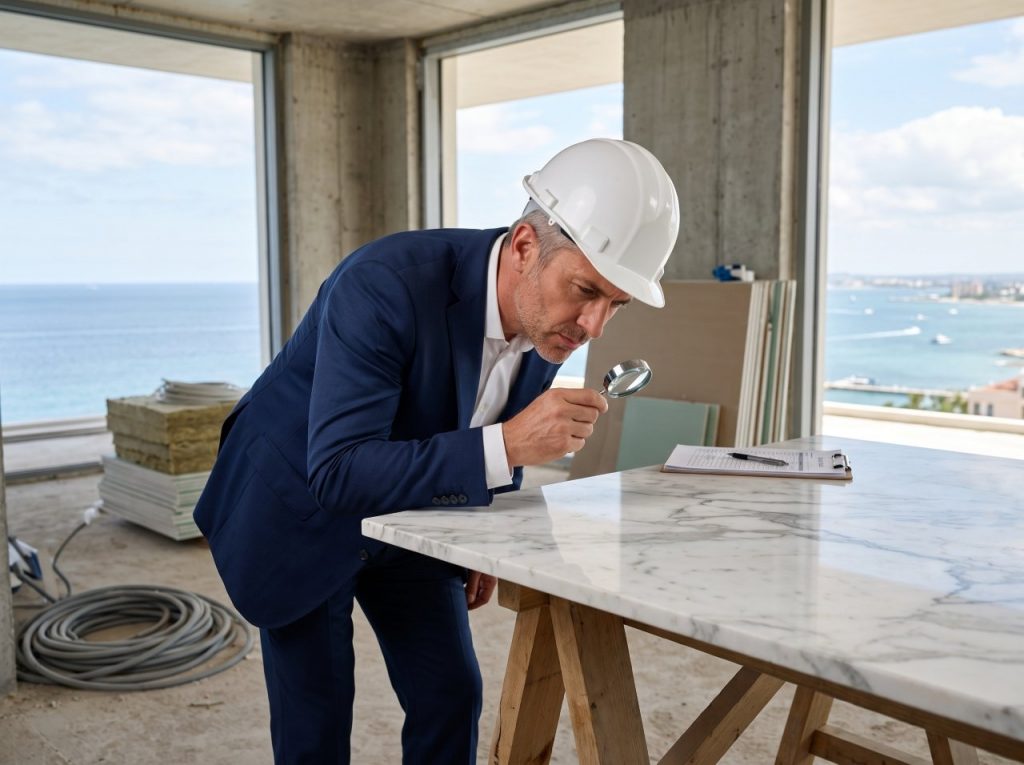
Purchasing an off-plan apartment from an obscure developer can be compared to venture capital investing: the growth potential is high, but the risk of capital freezes or diminished finishing quality is enormous. Investing in branded buildings is akin to buying “blue-chip” stocks in the concrete market. An automotive giant like Bugatti or a jewelry house like De Grisogono risks a century of reputation by granting a license to a local developer.
This is exactly why the franchisor dispatches its own engineers and designers to the construction site in Dubai. They verify everything: from the concrete grade and air purification systems to the thickness of the marble in the lobby. If the developer decides to cut corners and install lower-grade pipes, the brand will threaten to revoke the franchise. For the end buyer, this invisible conflict of interest between the developer and the brand serves as the ultimate guarantee that the brochure renders will perfectly match reality.
The Dubai Market Bubble — Myth or Reality for Ultra-Luxury?
The risk of market overheating applies exclusively to the mass-market segment, while ultra-luxury is protected by a physical land shortage along the coastline and a strict limit on the number of elite projects.
The media space is regularly flooded with forecasts about an impending drop in property prices per square meter in the Emirates. It is crucial to distinguish between suburban residential areas on the desert outskirts and premium locations. The mass market is indeed subject to cyclicality: if the influx of new expats slows down, rental rates adjust. However, the branded real estate segment operates under entirely different economic laws.
The primary driver of price growth for such properties is the physical impossibility of building new ones. The Persian Gulf coastline, the Palm Jumeirah islands, and the Dubai Water Canal are already heavily developed. The scarcity of premium land means that every new project launches at a price 10-15% higher than the last. Add to this the continuous influx of HNWIs (High Net Worth Individuals) relocating their capital to safe jurisdictions.
Expert Advice:
“When evaluating a property’s potential, always look at the developer’s land bank. If there is an empty lot next to your future haute-couture residence where a thirty-story economy-class building could be erected, the liquidity of your asset will be jeopardized. At Umbrella Group, we analyze the district’s master development plan 10 years ahead before recommending a project.”
The Social Filter: How Elite Infrastructure Impacts Property Liquidity
Purchasing branded real estate grants automatic access to a gated community, acting as a social filter and providing a level of service that anticipates the owner’s desires.
The decision to buy an ultra-luxury residence is rarely based solely on yield spreadsheets. For top managers, IT entrepreneurs, and investors, the quality of life and environment play a pivotal role. A branded building acts as a strict social filter. You are not buying concrete walls; you are buying proximity to people with similar values, status, and levels of awareness.
The philosophy of such projects is built on predictive comfort. The five-star hotel’s management company knows your habits: from your preferred pool water temperature to your SPA preferences. Eco-friendly materials, optimal insolation, and dedicated spaces for meditation and silence create the right spatial energy. This allows you to recharge effectively after running a business.
Furthermore, owning such real estate is the most comfortable path to legalization in the country. If your goal is a safe relocation and obtaining residency without drowning in bureaucracy, we recommend delegating the status processing and bank account openings to specialized lawyers. This saves time and eliminates errors during document submission.
The Illusion of Passive Income and Hidden Hotel Fees (The Cost of Mistakes)
The gross yield of 10% advertised by the developer on paper often turns into 5–6% net profit due to the deduction of the FF&E Reserve — a hidden depreciation fund for furniture and operational fees.\

Most branded projects offer investors a Rental Pool program. The mechanics look appealing: you hand the keys over to the hotel operator, they rent the apartment out on a short-term basis, and the profits are split (usually 60/40 or 70/30 in favor of the owner). However, the devil is in the structure of expenses deducted before the profit is distributed.
Many brokers “forget” to inform buyers about the existence of the FF&E (Furniture, Fixtures, and Equipment) Reserve. This is a mandatory depreciation fund. The hotel takes 3% to 5% of the gross income for the future replacement of carpets, mattresses, and appliances to ensure the residence perpetually meets five-star standards. Add to this the hotel’s marketing fees, Service Charges, and insurance.
The cost of a mistake when blindly signing a Rental Pool agreement is losing up to half of your expected profit. A professional broker’s job is to conduct a financial stress test of the contract before any deposit is paid, showing the client the real, not the marketing, ROI.
Investor Checklist: Rules for Safely Selecting Branded Real Estate
A secure transaction requires deep financial due diligence, verifying the status of the developer’s escrow accounts, and analyzing the historical yields of the chosen hotel operator.
To ensure that obtaining residency and buying luxury housing brings only positive emotions, the selection process must be grounded in cold calculation. We have compiled a basic pre-transaction verification algorithm:
- Operator Analysis: Find out exactly who will manage the building. It is one thing when the operator is the Dorchester Collection with vast experience managing luxury hotels, and quite another when an automotive brand simply sold the right to use its logo, while a third-party local company handles the management.
- Escrow Account Verification: In Dubai, investor funds are protected by law and held in specialized accounts. Ensure the project’s account is officially registered with the Dubai Land Department (DLD).
- Service Charges Evaluation: Request historical data on the maintenance cost per square foot in other completed projects by the same brand. This allows for accurate calculation of the asset’s holding costs.
- Exit Strategy Terms: Carefully study the contract section regarding the assignment of rights (NOC). Some developers prohibit resale until 30-40% of the property value has been paid.
Frequently Asked Questions (FAQ)
Can I live in a branded residence year-round if it is managed by a hotel?
Yes, most projects grant the owner the right to permanent residency. However, if you enter a guaranteed yield program (Rental Pool), the contract typically limits your personal stay to 14 to 30 days per year. Conditions vary depending on the specific operator.
Does UAE residency offer tax benefits for property owners?
The United Arab Emirates offers one of the most favorable tax systems in the world. Upon obtaining tax residency status, you are exempt from personal income taxes, capital gains taxes on real estate sales, and inheritance taxes.
What is the timeline for obtaining a Golden Visa when buying ready property?
If the project is completed and you have received your Title Deed, the process of handling documentation, undergoing a medical exam, and submitting biometrics takes an average of 14 to 21 days. For off-plan properties, you can apply for the visa once you have paid the minimum investment threshold set by the government.
How quickly can the property be resold?
High liquidity is the primary characteristic of trophy assets. Historical data indicates that world-renowned branded apartments find a new buyer on the secondary market 1.5 to 2 times faster than standard premium lots in the same location, especially if the property is ready to move into.
Any residence in Dubai is a powerful tool for wealth multiplication, but only if subjected to detailed legal and financial analysis. Do not select properties based on beautiful renders and promises of high returns. Contact the Umbrella Group team, and we will conduct an independent audit of your chosen project, safeguarding your time and money.