
Table of Contents
- 1-Minute Summary:
- The Anatomy of a TAPU: How to Read the Ultimate Ownership Document?
- The 2026 Step-by-Step Algorithm: From Choosing a Villa to Keys and a Passport
- Cadastral vs. Market Value: The Ultimate Trap for Investors
- Due Diligence Before Purchase: Encumbrances, Iskan, and “Closed” Neighborhoods
- TAPU as an Investment Tool: Residency and Citizenship in 2026
- Frequently Asked Questions (FAQ)
- Security Strategy: How to Protect Your Capital During a Deal
The TAPU (Tapu Senedi) is the only official document that confirms your absolute right of ownership to a property in the Republic of Turkey. If you are currently building your portfolio and considering highly liquid real estate in Turkey for investment, it is strictly vital to understand the legal side of the process before making your first deposit. No notarized sales contracts, receipts from the developer, or apartment keys make you the legal owner of the asset. Only registration with the Land Registry Directorate (Tapu ve Kadastro Genel Müdürlüğü) solidifies the transfer of ownership. Over 25 years in the market, experts regularly witness situations where investors lose their capital due to a misunderstanding of one simple fact: the process of obtaining a title deed here is fundamentally different from that in Europe or Dubai.
1-Minute Summary:
- The deal is not complete until the TAPU is issued: Paying 100% of the property value under a contract does not grant ownership rights until the data is entered into the state Land Registry.
- New 2026 thresholds: Obtaining a residence permit (Ikamet) via a TAPU in Turkey in 2026 is only possible with an expert property valuation of at least $200,000, and citizenship requires an investment starting at $400,000.
- Currency exchange control: The DAB certificate, which mandates the conversion of foreign currency into Turkish Lira, strictly ties the value of your asset to the Central Bank’s exchange rate on the day of the transaction.
- The cadastral value risk: If a developer under-declares the property price on the document to save on taxes, it permanently strips the foreign buyer of the right to apply for an investment-based residence permit.
The Anatomy of a TAPU: How to Read the Ultimate Ownership Document?
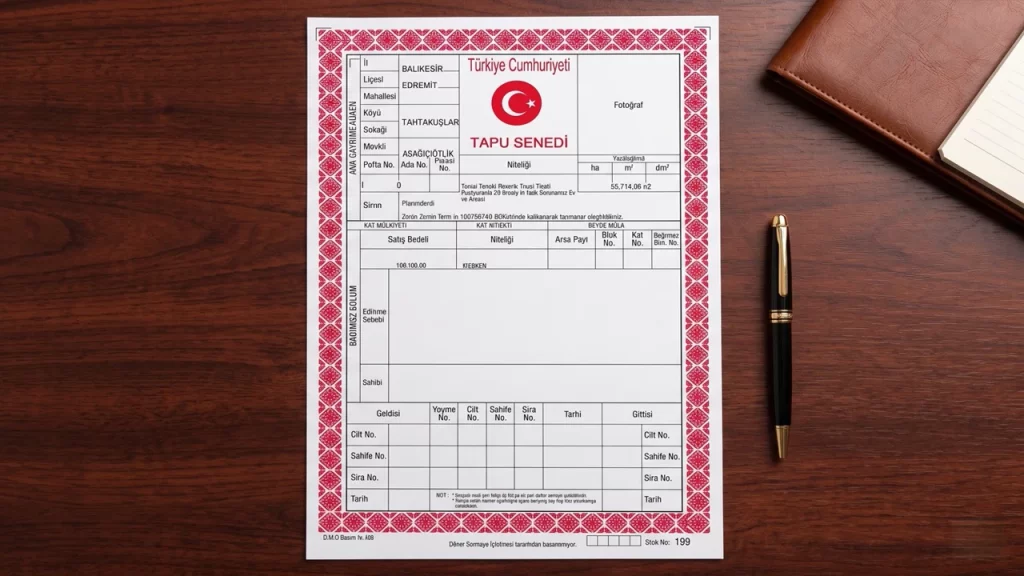
When trying to understand what a TAPU for an apartment or land in Turkey is, it is essential to know that it is an extract from a unified state registry. It contains the full history of the property, land characteristics, owner’s shares, and, most importantly, the presence of any encumbrances. The document holds absolute legal power.
Color Differentiation of Title Deeds: Residential Real Estate vs. Land Plots
When reviewing the types of TAPU in Turkey, investors are often confused by the color differentiation of the documents. The color of the folder determines the purpose of the asset.
A Red Title Deed is issued for residential and commercial real estate properties (apartments, villas, offices, retail spaces). It registers property that has:
- Kat İrtifakı (Construction Servitude): Ownership rights to a share of the land with an approved construction plan. This is issued at the off-plan (excavation) stage.
- Kat Mülkiyeti (Full Ownership): The final document confirming that the building has been commissioned, the municipality has issued the technical passport (Iskan), and the property is fully suitable for habitation.
A Blue Title Deed is issued for land plots. If you are buying agricultural land (Tarla) or a plot for development (Arsa), you will receive a blue document. Investing in land is more complex for foreigners: there are strict area limits (no more than 30 hectares nationwide) and an obligation to develop a project within two years.
Decoding the Fields: What to Look for in the Document
The Turkish language and specific terminology turn reading the document into a complex quest. When analyzing the title deed, your focus should be on three main areas:
- Niteliği (Property Type/Status): Make sure it indicates a residential or commercial property, not an agricultural plot.
- Arsa Payı (Land Share): In Turkey, you don’t just buy the walls of your apartment; you buy a proportional share of the land underneath the building. This figure reflects your voting weight in the building’s management.
- Sahibi (Owner): Several people (spouses, children, business partners) can be registered on the document, specifying exact ownership shares (e.g., 1/2 or 1/4).
The 2026 Step-by-Step Algorithm: From Choosing a Villa to Keys and a Passport
The procedure for obtaining a title deed takes anywhere from 3 to 14 days and requires a strict sequence: from getting a Tax ID and opening a bank account to conducting an independent valuation, converting currency, and signing off at the Land Registry Office.
Stage 1: Compliance, Tax ID, and Independent Property Valuation
After reserving the property and signing the Sales and Purchase Agreement (SPA), the legal groundwork begins. A foreign national must obtain a Turkish Tax Identification Number (Vergi Numarası) and open an account with a local bank. The crucial step here is the Ekspertiz Raporu (Independent Valuation Report). A state-certified appraiser visits the site and determines its true market value. This document is valid for exactly 3 months and serves as the baseline for the tax authorities.
Stage 2: The Financial Cordon and the DAB Certificate
Turkish law prohibits direct foreign currency settlements when foreigners purchase real estate. The buyer must transfer Dollars or Euros to their Turkish bank account and sell them to the Central Bank of Turkey. In return, the bank issues a DAB (Döviz Alım Belgesi) — a Foreign Exchange Purchase Certificate. Without the DAB, the Land Registry Office will outright refuse to process the transaction.
To avoid carrying cash in suitcases and to protect capital, institutional investors use the Tapu Takas system. This is a government-run escrow service: funds are blocked in a transit account and are released to the seller only at the exact second the ownership rights are transferred. The mechanism works like a digital letter of credit, completely eliminating fraud.
Stage 3: Transfer of Rights (Tapu Dairesi)
The final chord takes place at the Land Registry Office. The seller, buyer, and a state-sworn translator (if the buyer does not speak Turkish) must be present at the transaction. The parties confirm that there are no financial claims against each other, sign the registry books, and the buyer is handed the title deed printed in their name.
If you manage substantial capital and value your time, the routine involving banks, appraisers, and DAB certificates should be delegated. Our team helps you navigate this journey remotely, acting as your reliable property management partner based on a Power of Attorney strictly limited to purchasing authority.

Cadastral vs. Market Value: The Ultimate Trap for Investors
The main risk in the Turkish market is the discrepancy between the actual price of the property and the amount declared on the TAPU. Agreeing to under-declare the value strips the foreign buyer of the right to apply for citizenship or residency by investment.
Many local developers have historically listed a lower property value on official documents. Their motive is transparent: minimizing corporate income tax and reducing the one-time title deed transfer tax (which is 4% of the declared amount, traditionally split evenly between buyer and seller).
For a local Turkish buyer, this isn’t critical. For a foreigner, it is fatal. If you paid $450,000 for a villa, but the TAPU reflects the equivalent of $150,000, the state only acknowledges the latter figure. The door to a passport is firmly shut.
Expert Tip (Mila Grebenschikova):
“In 2026, we are seeing a strict pegging of investment thresholds to the national currency based on the exchange rate on the day the DAB certificate is obtained. Lira fluctuations can drop the dollar valuation of your villa below the $200,000 threshold overnight. At Umbrella Group, we always build a ‘safety buffer’ of 10-15% into the property’s price during transaction preparation to hedge our clients against currency risks.”
Due Diligence Before Purchase: Encumbrances, Iskan, and “Closed” Neighborhoods
Attempting to save money by skipping a professional property audit often results in buying highly illiquid assets. The main threats are: liens on the property (İpotek / Şerh), the absence of an Iskan, and choosing a “closed” neighborhood where issuing an Ikamet is prohibited.
Investing without deep Due Diligence is akin to playing roulette. The cost of a mistake is measured in hundreds of thousands of dollars. Before putting down a deposit, the property must be vetted across three key parameters:
- Encumbrances (Şerh): An extract is requested from the Land Registry Office. The apartment could be mortgaged to a bank, have unpaid complex maintenance debts (Aidat), or carry demolition orders due to seismic safety violations.
- Absence of a Technical Passport (Iskan): Selling a property without an Iskan means the building has not been approved by the municipality. Water and electricity tariffs in such a building will be billed at commercial (double) rates, and obtaining a residency permit via TAPU will be impossible.
- Closed Neighborhoods: The Turkish Ministry of Interior regularly updates the list of districts where the density of foreign citizens has exceeded 20%. Buying property in these locations grants you ownership but blocks your ability to apply for a tourist or investment residence permit.
Capital security demands cold analytics. By entrusting the audit to the Umbrella Group team, you receive a full legal property check ensuring the absence of debts, a seismic resistance analysis of the building, and a guarantee that the location aligns with your immigration goals.
TAPU as an Investment Tool: Residency and Citizenship in 2026
The title deed acts as the direct foundation for legalizing your status in the country. The minimum investment threshold for obtaining a Residence Permit (Ikamet) is $200,000, while securing a Turkish passport through the fast-track program requires purchasing real estate worth at least $400,000.
Current Requirements for Properties and Amounts
The rules of the Turkey Golden Visa program and investment Ikamet have undergone changes to weed out speculative capital and protect the economy from overheating. To obtain a residence permit based on property ownership, the asset must meet the following criteria:
- Valuation: The amount in the expert report and the DAB certificate must strictly exceed the state-established limits ($200,000 / $400,000) in their Lira equivalent on the day of the transaction.
- Resale Restriction: To retain citizenship, the investor is obligated not to sell the asset for 3 years. A corresponding encumbrance note is stamped directly onto the TAPU form.
- Ownership History: A property used to acquire a passport must not have belonged to foreigners during the last three years. You cannot “pass around” the same villa to secure passports for multiple different buyers.
Strategies for Institutional Investors (B2B)
Family offices and investment funds view the Turkish real estate market not only as a tool to acquire a second passport but also as a robust portfolio diversification mechanism. Istanbul consistently demonstrates a steady increase in the price per square meter in hard currency, while the premium districts of the Antalya coast provide high yields from short-term rentals.
For large-scale acquisitions, properly structuring the deal is paramount.
| Parameter | Purchasing as an Individual | Purchasing via a Legal Entity (Turkish Company) |
| Title Deed Transfer Tax (Tapu Harcı) | 4% (usually split 2% buyer / 2% seller) | 4% |
| Annual Property Tax (Emlak Vergisi) | 0.1% – 0.2% of the cadastral value | 0.1% – 0.2% |
| Rental Income Tax | Progressive scale (from 15% to 40%) | Corporate tax (fixed percentage) |
| Citizenship / Residency Limitations | Grants the right to Residency/Citizenship | Does NOT grant Residency/Citizenship to the founders |
It is evident that to generate passive rental income (yield), it is more profitable for institutional investors to set up local companies, whereas to solve immigration goals, the asset must be registered exclusively to an individual.
Frequently Asked Questions (FAQ)
Can one TAPU be issued to multiple people?
Yes. Turkish law allows an unlimited number of owners (friends, relatives, business partners) to be registered on the document. The exact share of each individual (e.g., 1/3) will be recorded in the registry. However, only one person—or an officially married couple—will be able to apply for a residency permit via TAPU in Turkey in 2026, provided that each person’s share meets the minimum investment threshold.
What happens if the document is lost?
Losing the physical paper does not mean losing your ownership rights. All data is securely stored in the Land Registry Directorate’s electronic database. The owner simply needs to visit the office with their passport, pay a small state fee, and a new title deed will be issued within an hour.
Does commercial real estate qualify for citizenship?
Yes. The Citizenship by Investment program does not limit investors to residential properties. Purchasing a hotel, an office floor, or street-retail space worth $400,000 or more also allows you to submit documents for a passport.
Security Strategy: How to Protect Your Capital During a Deal
The procedure for getting a TAPU in Turkey is a well-oiled government mechanism that protects the investor, provided the rules of the game are strictly followed. The transition from bureaucratic paperwork to enjoying life in a new seaside apartment or a penthouse overlooking the Bosphorus requires only one thing — competent risk management right from the start.
Choosing a reliable broker eliminates stress from the investment process. Leave the tasks of verifying the Iskan, hedging exchange rate gaps when obtaining the DAB certificate, and communicating with cadastral authorities to the professionals. By securing comprehensive transaction support from the Umbrella Group team, you gain more than just a piece of paper; you acquire a heavily protected asset that guarantees you and your family safety, global mobility, and stable passive income. All you have to do is choose the view from your window.